A powerful earthquake measuring magnitude 6.0 shook the province of Eastern Samar on the afternoon of Sunday, May 4, 2026, prompting an immediate warning from the Philippine Institute of Volcanology and Seismology (PHIVOLCS-DOST) that structural damage and subsequent aftershocks are to be anticipated in affected communities.
What Happened and Where
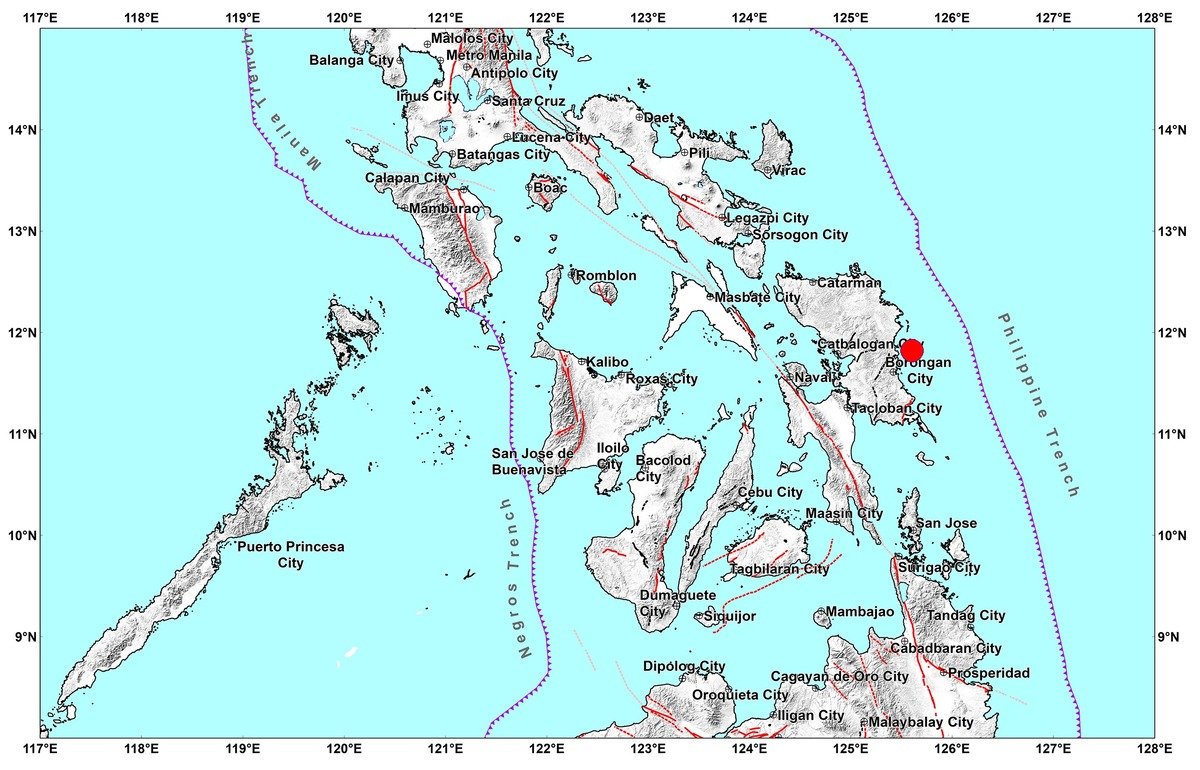
The tremor struck at precisely 2:09:46 in the afternoon, Philippine Standard Time. PHIVOLCS pinpointed the epicenter approximately 18 kilometers north of the municipality of San Julian in Eastern Samar, with geographic coordinates recorded at 11.82°N latitude and 125.61°E longitude. The quake originated from tectonic activity at a focal depth of 57 kilometers beneath the surface.
Tectonic earthquakes of this depth are generally classified as shallow to intermediate, and the combination of magnitude and relatively moderate depth contributed to the wide area over which ground shaking was felt across Eastern Visayas and neighboring regions.
Strongest Shaking Near the Epicenter
The communities closest to the epicenter bore the brunt of the seismic event. Both San Julian and Salcedo in Eastern Samar recorded Intensity VI on the PHIVOLCS Earthquake Intensity Scale — a level described as “very strong” shaking. At this intensity, poorly constructed buildings and structures are susceptible to slight damage, and the event is strong enough to alarm residents and cause objects to fall.
Intensity V, categorized as “strong” shaking, was reported in Can-Avid, Sulat, and Taft — all located within Eastern Samar. At this level of ground motion, nearly everyone in the affected area feels the shaking, and unsecured hanging objects swing noticeably.
Intensity IV Shaking Spreads Across Eastern Visayas
A broad swath of Eastern Visayas experienced Intensity IV or “moderately strong” shaking, covering a significant number of towns and cities across multiple provinces.
Within Eastern Samar itself, Intensity IV was felt in Arteche, Balangiga, Balangkayan, Borongan City, Dolores, General Macarthur, Giporlos, Hernani, Jipapad, Lawaan, Llorente, Maslog, Maydolong, Oras, Quinapondan, and San Policarpo.
In Leyte province, the same intensity level was recorded in Alangalang, Burauen, Carigara, Dagami, Dulag, Julita, Palo, Pastrana, Santa Fe, Tabontabon, Tanauan, and Tolosa, as well as in Tacloban City — the regional center of Eastern Visayas.
Northern Samar also felt Intensity IV in several municipalities: Catubig, Gamay, Laoang, Lapinig, Mapanas, Mondragon, Palapag, Pambujan, Rosario, San Roque, and Silvino Lobos. In the province of Samar, Intensity IV shaking was recorded in Calbayog City, Catbalogan City, and 15 additional municipalities. Loreto in Dinagat Islands likewise registered this intensity level.
Weaker Shaking Reaches Neighboring Provinces
The reach of the earthquake extended well beyond Eastern Visayas. Intensity III — a level that is clearly perceptible but generally causes little to no damage — was felt in Casiguran and Juban in Sorsogon province, as well as in Duero, Bohol. All municipalities in Biliran province registered Intensity III, along with additional areas in Eastern Samar, wide sections of Leyte including Ormoc City, Northern Samar, Samar, Southern Leyte, and portions of Dinagat Islands.
Lighter Intensity II shaking was detected in parts of Masbate, Cebu, and Southern Leyte. The tremor’s faintest traces — Intensity I — were picked up by instruments in select areas of Cebu, including Cebu City and Lapu-Lapu City.
Seismographic Instrument Readings
Beyond felt reports from residents, PHIVOLCS seismographic instruments independently confirmed ground motion readings. Instrumental Intensity V was recorded in Can-Avid in Eastern Samar, Alangalang and Dulag in Leyte, and both Catbalogan City and Gandara in Samar province. Instrumental Intensity IV readings were captured at monitoring stations in several Leyte municipalities and Northern Samar areas. Lower-level instrumental readings extended as far as the provinces of Albay, Camarines Sur, and Catanduanes in the Bicol Region — underscoring the extensive reach of the seismic event.
Damage Expected; Aftershocks Warned
PHIVOLCS has been direct in its assessment: damage is expected as a result of this earthquake, especially in areas that registered Intensity VI shaking near the epicenter. The agency’s official bulletin explicitly warns that aftershocks should be anticipated following the main event, as is typical with earthquakes of this magnitude.
Residents living in the communities nearest the epicenter in Eastern Samar are being advised to thoroughly inspect their homes, buildings, and surrounding structures for cracks, fissures, or signs of compromise. Any areas that experienced Intensity IV or higher shaking should remain on alert and avoid entering damaged structures until they have been assessed as safe.
People in affected zones are also encouraged to stay away from coastlines as a precautionary measure, and to follow guidance from local government units and disaster risk reduction offices regarding evacuation or shelter protocols.
Official Bulletin and Monitoring
PHIVOLCS released its earthquake information bulletin at 6:18 in the evening of May 4, 2026, Philippine Standard Time — roughly four hours after the event occurred. The agency noted in its bulletin that this would serve as the sole official release for this particular earthquake unless new or significant information comes to light that warrants a follow-up advisory.
An epicentral map showing the precise location of the earthquake has been made available by the agency for public reference. Residents, local officials, and emergency response teams are urged to monitor official updates directly through the PHIVOLCS website at phivolcs.dost.gov.ph for the latest advisories on aftershock activity and damage assessments.
The Office of Civil Defense (OCD) and the National Disaster Risk Reduction and Management Council (NDRRMC) are expected to coordinate with local government units in Eastern Samar and throughout Eastern Visayas to assess the extent of any damage on the ground following the tremor.